Quest Store Index, every Quest app on one page
With a game launch coming up (Fruitland), I wanted to see what else is on the Quest, and the store is not built for browsing:
can you index all games for the quest so I can browse them hassle free and bookmark etc etc? pretty sure the actual quest store wont let me do that easily. meta quest, the vr headset. for my upcoming game launch and market reserach
The result is a single local page with every Quest app in it: search across names, developers and descriptions, filters for genre, price, rating count, score, release year, play area, controls and headset, a grid or a table, a star on each game with tags and a note, and CSV export of whatever is on screen. The whole view lives in the URL, so a browser bookmark brings a filter back.
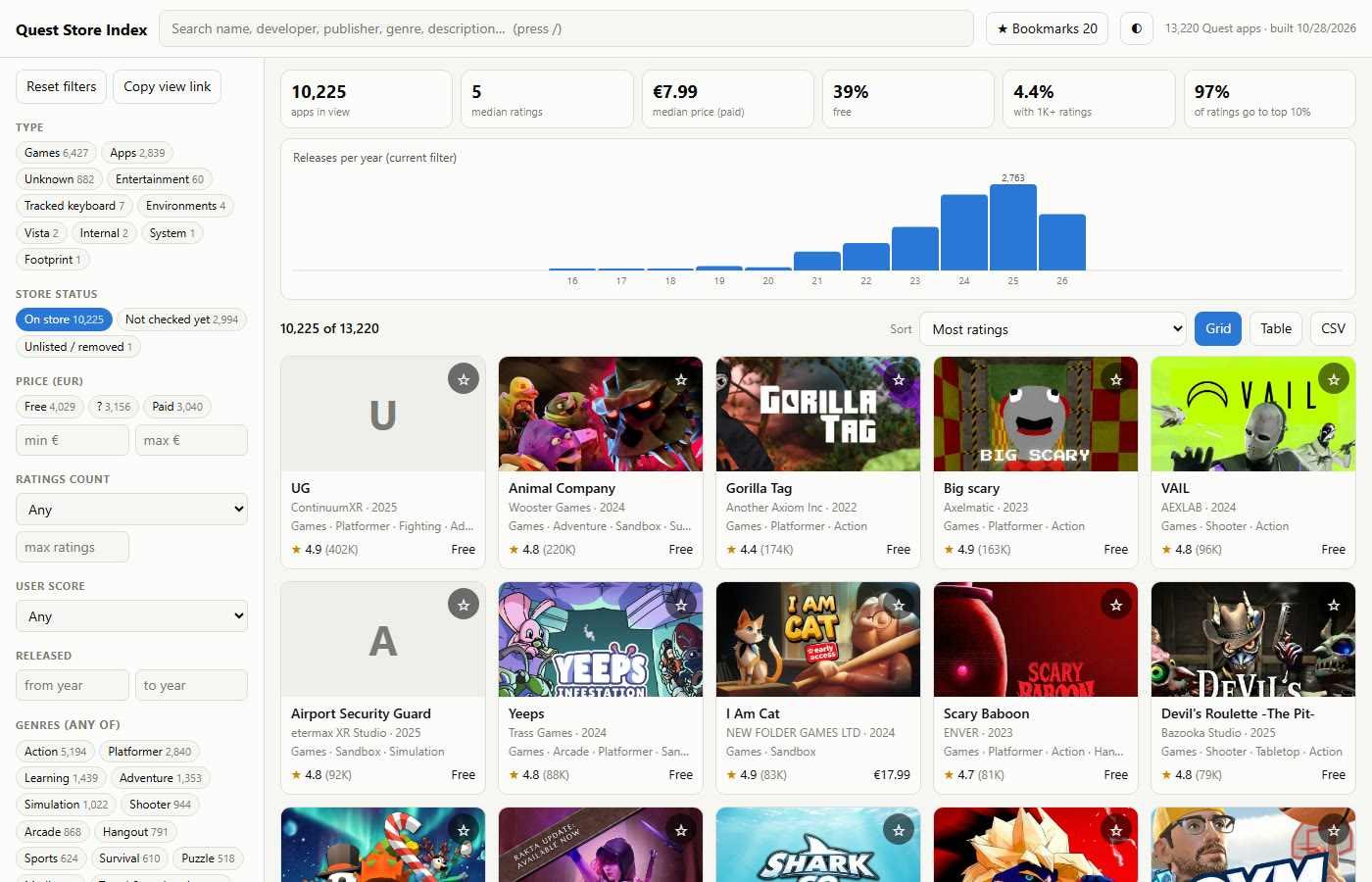
Where the numbers come from
The list comes from OculusDB, a free public database of Quest apps that also keeps App Lab and removed titles. The details (exact ratings, written reviews, release date, developer, player modes, EUR price) come from Meta's own store. It answers curl with a 400, so those queries run inside a logged-out meta.com tab in a real Chrome. VRDB.app has similar data, but its terms forbid scraping, so it isn't used.
Meta stops answering anonymous requests after a few hundred quick ones, and the block lasts. The fetcher goes slowly, and when it is blocked it sends one probe every ten minutes instead of switching sessions to get around it. Three days later it has detail records for about 10,500 apps and is still waiting out a block this morning.
What Fruitland would sit next to
About an hour after the first prompt I asked for the comparison:
knowing fruitland... can you make a selection of games that come closest to similarity? I guess they would also be similar to astrobot rescue mission. so a platformer but 3rd person camera
There is no Astro Bot on Quest. Twenty games were starred and tagged in four groups: the closest third-person platformers, games where you guide a small hero through a diorama, mixed-reality dioramas, and cute games for the same audience in first person. Rating counts stand in for sales here, and they are not sales.
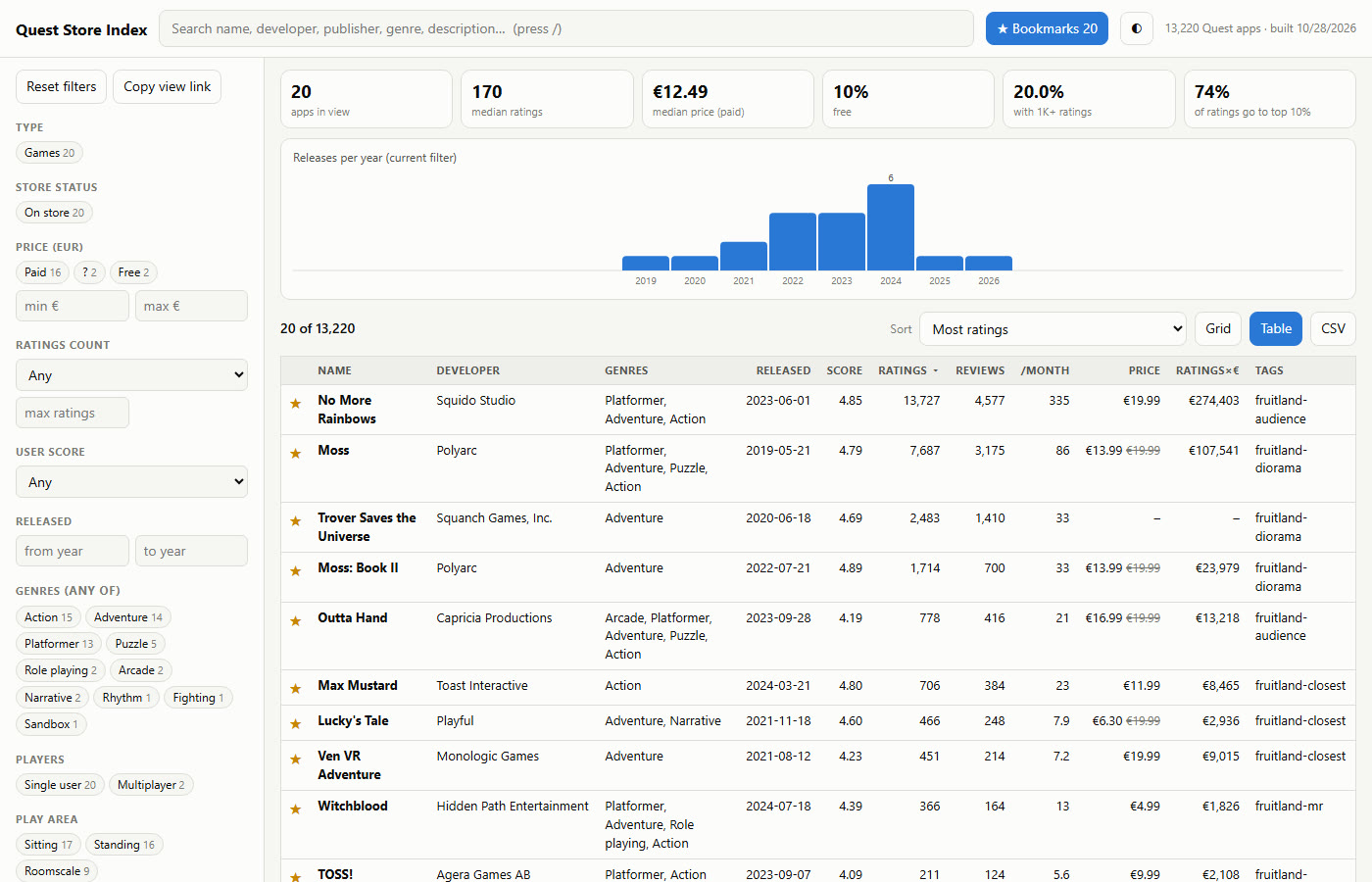
What the table says: no pure third-person platformer on Quest has passed 1,000 ratings. Max Mustard leads with 706, about 23 a month. Moss, where you guide a small mouse through a diorama with your hands, has eleven times that. No More Rainbows, cute but first-person, has more than 13,000. And one game is almost the same pitch: Nimbi's Adventures, a mushroom mascot in a "life-size toy diorama" with double jumps and coins, in early access since August, with no ratings yet when the list was made.
How long people stay in VR
The next morning a different question:
is there any data on how long people spend in any app or game in one run? I would like to investigate what makes a VR experience easier on the eyes and head but not from what people think but from real data. obviously frequent breaks do which is also reflected in short-round games like beat saber or minigolf vr grossing a lot more because people can play it more because it naturally has breaks in it...
Nobody publishes that. Meta records it but shows each developer only their own app. What is public is Steam: a public Steam profile says which game its owner is in right now. Watch a fixed group of players every minute and you get when each session starts and stops, for every PC VR game at once. The hypothesis it is meant to test came in the next message:
I think it's also actually BAD practice to have no natural breaks in a game cause then the headache sets in but you wanna keep playing but it hurts and now you associate the game with pain and next thing you know you're not playing anymore at all. ... yes that's also what I am realizing doing fruitland now... because I switched to taking voice notes in-game so I would not always have to take off the headset for notes and suddenly I get strain and it's not as fun anymore... so yeah I think the magic formula approximation is to have a TON of content to discover... like hours and hours because diving into a new VR world is SO amazing but then have the average playtime be super short until a natural break, like 2 to 15 minutes tops.
So the analysis measures session length per game, continuous stretches in the headset across games, and the test of the idea: after a long run, does the same player come back to VR less often in the next three days than they usually do? Each player is compared with themselves, so heavy players don't make long sessions look healthy. Before any real data came in, it was run on a made-up week with known answers, and it found the planted 10 and 70 minute sessions and the planted effect.
- apps
- 13,220 in the list, 10,225 on the store today, 2,994 not checked yet
- sources
- OculusDB's open API for the list, Meta's store GraphQL from a logged-out tab for the details
- page
- one HTML file opened from disk, data as plain script files beside it
- bookmarks
- synced through a small PHP store on the webspace; newer wins per game, deletions stick
- Steam panel
- 100 public profiles, recent reviewers of the 15 most-reviewed VR games
- first two days
- 49 watched hours, 9 players seen in VR, 19 complete VR sessions
Still rough
The Steam study has barely started. The proper route needs a Steam Web API key, which Steam only hands out to accounts with its mobile authenticator. Asked to set that up, I wrote back "I dont need another app". So it runs without a key on a hundred profiles, one request each, and Steam Community answers too much traffic with empty 500s, several times a day. Nineteen sessions with a median of 22 minutes is an anecdote, not a finding. The verdict on breaks needs about two weeks, because every session needs three watched days after it. It sees PC VR only, never Quest standalone play, and nothing while the laptop sleeps.
The index started with a local server and became a plain file on the second day:
can you make the quest store index a simple HTML file (data can be json or whatever but its on this machine anyway)... so we dont need the server its kind aunnecesarzy... speaking of which look through currently running processes on this machine for anything leftover
The leftover turned out to be a headless Chrome from some other job, 76 processes and 7.3 GB of memory, that had been adding tabs since 23 October. It is gone now.
The index isn't linked here. It is a page on this laptop, and the data in it is Meta's.