A Vinted scout that reads the label
A month earlier I had built a watcher for Kleinanzeigen. Just before midnight on 14 October I asked for the same thing for Vinted:
ok similar to what we built in ../kleinanzeigen-... a vinted "scraper" that just find interesting pieces through several methods... one of them being great brands and their affordable offers (prada, loro piana, ...) and others being certain searches that I will feed you over time
Vinted's own search has two problems. It forgets sizes, and it believes titles. Twenty
minutes in I named the first one: another thing vinted is terrible at: remembering my
sizes: for clothes too big doesnt matter since I get most tailored anyway... my tailor said
wool cashmere etc are next to impossible to tailor
. That became the fit rules: too big
is fine, except knitwear, which cannot be taken in. Half an hour later came the second:
another popular search of mine is cashmere and silk or any mixture of those... however most listings then basically nver show the label or it's polyester with a cashmere feel or so so ... we COULD use an AI budget for those to filter by exactly those rules: show label or it's fake
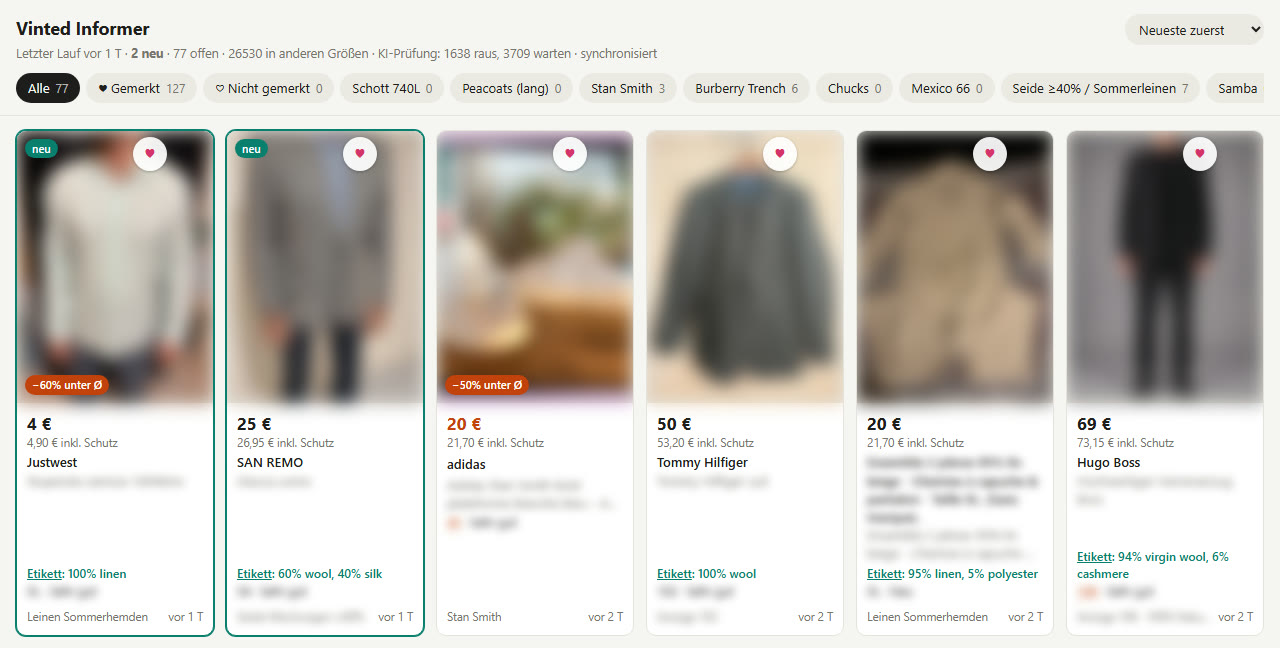
One page, twice a day
A Windows task runs at ten in the morning and ten at night, or as soon as the laptop is back on, and a missed week counts as one run, not seven. Each run fetches the public search pages with plain HTTP, about twenty requests with a few seconds' pause between them, and without logging in, so there is no account to lose. Any sign of a block pauses everything for half an hour, doubling up to six hours. The run then writes one page, newest first, and uploads it, and a small store on the webspace keeps what I saved or removed in step between laptop and phone.
The searches, 28 now, are of three kinds. Brands with a price cap that goes into the search itself (Loro Piana under €150, Prada under €80). Specific pieces, where a word list cuts Vinted's loose matching back to the actual model, since a search for Stan Smith returns every adidas shoe. And materials, where nothing on the page can be trusted until someone has seen the label.
The first surprise was in the data, not the brief. Sorting by newest first is not strict: two runs a minute apart, 44 of 96 Schott results had never been shown before, all of them older than the newest one already known. So a listing counts as new only if its id beats everything that watch has seen; the rest are stored quietly. A badge such as −60% below average compares the price with the median of everything the watch has ever matched.
18 October
The busiest day in the transcripts was a Sunday afternoon of small, sharp corrections.
Trousers became one exact size only (there are plenty of pants and jeans
). Suits of
natural fibre in my size went in, Italian sizes included, and I can just ask the seller
for the label
. A tab for everything not yet saved. Then:
actually while we're at it also make every run remove items that have been sold already
followed by also remove them from saved... if they were sold theres not much point
keeping them saved
. When the plan was to hide removed cards, I said no need to hide
anything, you can delete if I x something
, interrupted myself, and took it back a
minute later: oh wait of course you should probably remember the IDs of deleted ones...
yeah you're right if we completely delete then they will just come back at the next
scrape. my bad
. So a removed listing is deleted and its id kept, and the next search
does not bring it back.
That button has been used. 7,766 listings have been clicked away by hand, one at a time or with remove everything up to here, and 677 more were dropped because they had sold or vanished. The database now holds 137,367 listings seen since 14 October.
Reading the label
Only listings already in my size go to the model, newest first and taking turns between
searches. It gets up to eight photos and returns what the composition tag says, or that there
is none. Most of the time there is none: of 4,668 listings checked so far, 77 pass the
current rule, which since early November is at least 40% silk in the main fabric, or summer
linen. The rejects read like this: kein Etikett
; 36% wool, 25% silk, 25%
polyamide, 10% angora, 4% viscose
. The cost stayed small. In late October, asked whether
to raise the limit, I said we have not once even gotten above 10 cents a day
; the
last two weeks of the shared spend ledger show $1.04 for 2,129 calls.
The same trick does two other jobs. For tweed and herringbone suits, which I asked for
because most listings still have a modern suit with maybe a microscopic herringbone
patters
, the model scores from 0 to 5 how clearly the photos show the pattern from two
or three metres; 7 of the first 40 passed. For the Schott 740 peacoat, whose long cut
looks exactly like the regular one, it looks for a style number, a long-size tag or a tape
measure; the first 32 were all the regular coat.
- built
- Claude Code, 14 October to 12 November, the busiest day 18 October; some later changes by Codex
- runs on
- a Windows scheduled task on the laptop, twice a day; the page is uploaded after every run
- made with
- about 1,750 lines of Node, the built-in SQLite, plain
fetchon Vinted's server-rendered search pages; a small Claude model for the photos - so far
- 28 searches, 137,367 listings stored, 7,766 removed by hand, 677 found sold, 4,668 labels checked
Still rough
The page is mine only. It is not indexed, it is tied to my sizes, and its pictures are
other people's, so there is nothing here to open. The label queue is longer than the daily
allowance: the header says 3,709 listings are waiting. It depends on Vinted keeping its
search pages public and server-rendered; if they stop, the fallback is a real browser, as
the Kleinanzeigen watcher already uses. And it went quiet once: on 8 November the job had
run and found 0 new results
, after Codex had made some changes.