It hears what you actually said
My Hungarian is, in my own words at the time, a broken beginner to
intermediate
. What I could not find was
anything to simply talk at — out loud, badly, for ten minutes — that would talk back and
not turn every sentence into a lesson. So I asked for exactly that: the idea is that I
can freely talk to an AI voice.
It is called Beszélgetés, which means conversation. You hold the space bar, say something in Hungarian, and let go. Anna answers out loud.
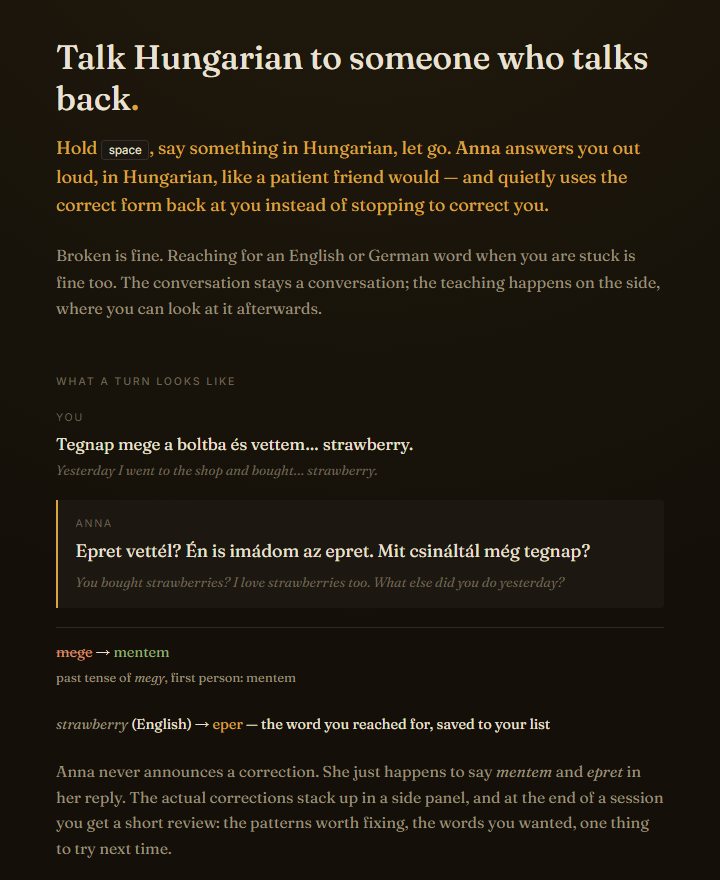
that was wrong— she just happens to use mentem and epret in her reply.
The one decision everything else follows from
Almost every speaking app works the same way: transcribe what you said, then grade the transcript. It sounds reasonable and it is quietly fatal. A transcriber is trained to produce correct Hungarian, so it repairs you on the way in. You say mege a bolt, it writes mentem a boltba, and the mistake you needed to see is gone before anything gets a chance to look at it. Pronunciation feedback is impossible for the same reason — a transcript has no accent in it.
So here the recording is never transcribed. It goes straight into a model that listens to audio, and comes back as what you actually said: errors intact, and the English or German word you grabbed when you got stuck left exactly where you put it.
The reply arrives as text after about eight seconds and as a voice roughly five seconds later, on purpose — synthesis takes about as long as thinking, and there is no reason to stare at a blank screen for both.
Corrections stay out of the conversation
Anna is instructed never to announce a correction, only to recast: use the right form herself, naturally, in whatever she says next. The real teaching piles up in a side panel and in a short review when you stop, so the talking stays talking. Click any correction to hear it said properly.
The words I reached for
The idea I like most came later: a list of every word I had to say in English or German because I did not have the Hungarian — sorted by how common that word actually is.
The ranking is corpus data, not a model's opinion: the top fifty thousand words from film subtitles, where line number is rank. Hungarian stacks suffixes onto everything, so each captured word is first reduced to its dictionary form plus a few common inflections and the best-ranked one wins. That is how érez, to feel, lands at #309, while kormányablak — the government office you queue at — sits somewhere past fifty thousand. Learn from the top down.
It costs money, so it has a door
Every turn costs real money, which is fine until a stranger finds it. So there is no account, but there is a code: enter it once and the browser remembers. Each code has its own daily allowance and its own private history, and the site as a whole has a ceiling so that one busy day cannot break it for everyone. History lives on the server, so a conversation started on the phone carries on at the desk.
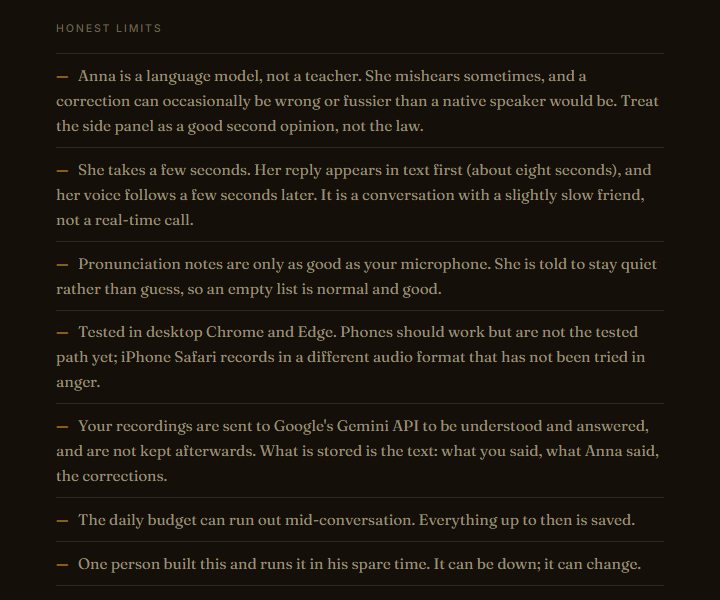
Still rough
She mishears. She is occasionally fussier than any real Hungarian would be. It is a conversation with a slightly slow friend, not a phone call, and it has only really been tested on a desktop. But it stays a conversation, which is the part every other tool I tried gave up first.
There is a free demo code on the page, good for a short conversation a day for a week, with no sign-up.