An open world at 256 × 240
When Nintendo started on Breath of the Wild, the first playable version was not 3D at all. It was a flat, top-down game in the style of the original NES Zelda, built to find out whether the physics and the chemistry were fun before anyone modelled a single mountain. I asked for the same thing, in one line at half past four on a Sunday morning:
seeing as how botw started out as a 8bit prototype to get the physics, chemistry etc right.... can we do the same? create a NES style open world game?
Forty minutes later there was a game. Four hours later it had a name, WILD 8, six quests and a boss, and it is the best thing an agent has built for me so far.
The chemistry is the game
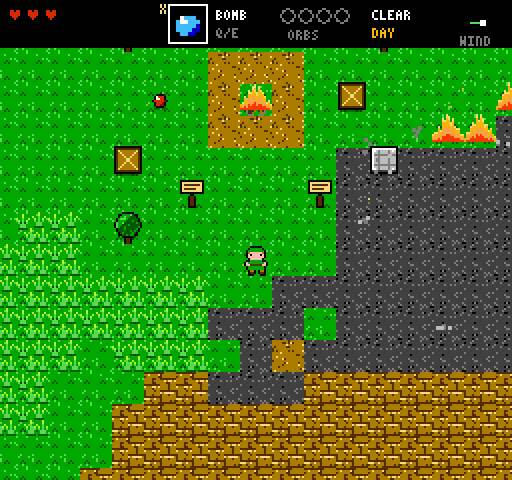
Every tile knows whether it burns, how long, and what it turns into. Fire spreads to its neighbours with a chance weighted by the wind, so a grass fire runs downwind and dies out against it. Grass burns to ash; in the snow it burns back down to dirt. Electricity flows from crystals through water and through anything metal lying on the ground, so a crate can be a wire. And in a storm, lightning picks metal near you seven times out of ten — which is the exact rule that makes you unequip your sword in a thunderstorm in the real game.
None of that is scripted per puzzle. The four shrines, the updraft you glide on above a campfire, and the boss fight at the end all use those same few rules.
Then it got height
The flat version had a problem that no amount of tuning fixes: in a game about climbing things, there was nothing to climb. After two rounds of playing it I said so:
why dont we just do add a 3rd dimension? but nothing polygonal, just minecraft style. 8bit but with height. everything can stay 8bit, even the old man can stay a sprite
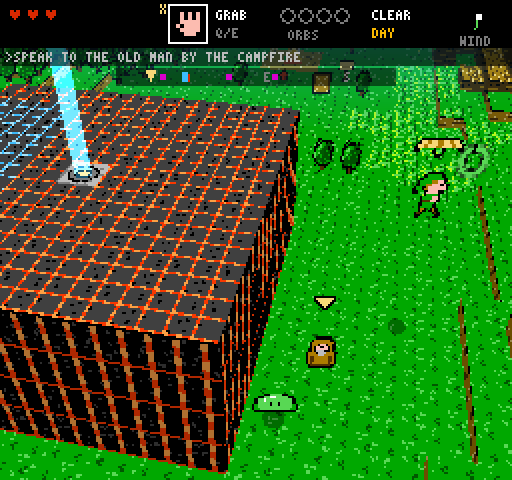
The simulation underneath did not change. The map is still a 160 × 128 grid of tiles; each one simply gained a height, and three.js draws the grid as blocks with the same 16-pixel NES textures on every face. The hero, the slimes and the old man stayed paper-thin sprites that turn to face the camera. Climbing now means climbing an actual wall, with stamina that drains only while you move — which took three tries and one bug report to get right.
Breath of the Wild in half an hour
Asked for more guidance, it did not add signposts. It went and copied the way the real game guides you: a tower that reveals the map, a light beam over whatever you are looking for, an old man by a campfire who has more to say than he lets on. Then, asked for more game, it compressed the main story into six quests:
- 1
- The Isolated Plateau — the tower, the glider, and a way off
- 2
- Seek the Elder — a village with houses you can climb
- 3
- Free the Four Spirits — four shrines, any order
- 4
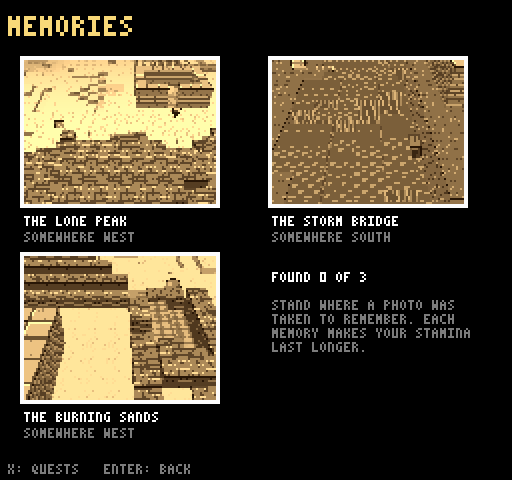
- Captured Memories — find where three old photos were taken
- 5
- The Hero's Sword — through the Lost Woods
- 6
- Destroy the Blight
The Lost Woods are my favourite piece. The forest is fogged, and straying from an invisible path sends you back to the entrance. The guide is your torch: its embers drift along the path ahead of you — carried by the same wind that spreads the fires.
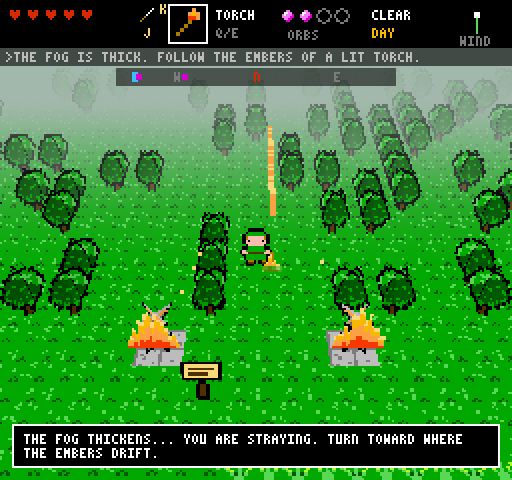
The first version of this was unplayable, and it is the best bug of the morning. I reported walking in with a lit torch and seeing only three glowing dots before being sent back. The fog was measured from the camera, which sits fourteen blocks behind the hero, so it hid the entire world including me. The agent's own screenshots had missed it because the fog fades in, and the test only captured the first frame. After the fix, a bot that did nothing but follow the embers walked from the entrance to the grove without being sent back once.
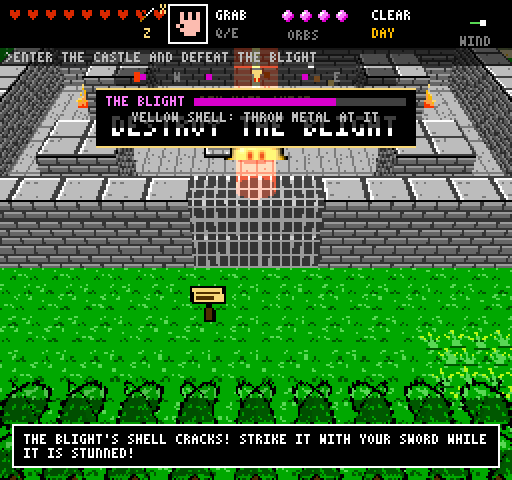
The Blight at the end wears an elemental shell, and a blade just bounces off it. The weakness cycles — a bomb for the orange shell, fire for the blue one, and for the yellow one you throw a metal crate at it — and only a cracked shell lets the sword in.
How it was made
Nine messages from me, each one mostly a bug report from actually playing: climbing
cost nothing while standing still; it rained and thundered far too much for the start of
the game; the water shrine made no sense; I got stuck in the old man after falling from
the tower. classic you
. The agent fixed each one, and verified the fixes by driving the
game from a headless browser rather than asking me to try again.
- code
- 3,271 lines of JavaScript, plus three.js for the blocks
- assets
- none — every tile, sprite and sound effect is generated in code
- resolution
- 256 × 240, the NES screen, scaled up
- world
- 160 × 128 tiles, five regions, weather per region
- built
- one Sunday morning, 04:34 to 08:30
- length
- about half an hour — the agent's estimate, nobody has timed it
Still rough
It needs a keyboard — there are no touch controls, so it will not play on a phone — and the half hour is a guess. The quests are there because I asked for them, not because anyone balanced them. If you get stuck, press P: there is a developer menu with eight save slots, one per chapter, and a god mode I will not judge you for.
It rhymes with Diorama from earlier this week — another agent, another Zelda, the opposite direction. That one went for how the Switch remakes look. This one went for why the original works.