Sixteen sleeves for a power strip
There is a power strip on my desk. It is grey, it has a model number moulded into the side, and it is the ugliest object in the room by a distance. So: a sleeve that drops over it from the top, 216 × 72 × 38 mm, open at the bottom so it appears to float a couple of millimetres above the desk. No screws, no lid, no supports.
The measurements are the project
Nothing here came out of a catalogue. Every number was measured by hand on the actual strip and written down verbatim, quotes and all, at the top of the parameter file — and the rule is that those measurements win. If something downstream does not work, the design changes, not the measurement. Anything that was not measured is labelled ASSUMED or DERIVED so it can never quietly get promoted to fact.
It reads like a transcript, because it is one:
- "18.5cm long, 5.5cm wide" · "43mm high" · "a model number on the side IU-432"
- "diameter of the plug holes 3,9cm" — then, against the printed test rings: "the holes fit exactly but we might as well make them 0.5mm bigger"
- "center to center is closer to 42mm" · "distance of last hole to end ca 10mm"
- "the switch is oriented the other way" — then, against the printed box: "too small … about 2mm each side", so 23 × 28
- "the long sides come out far … def too much" — the case went from 79.4 to 72.4 mm
Two of the notes cannot both be true: a 42 mm pitch with 40 mm recesses leaves a 2 mm web between them, not the 3 mm that was measured. That contradiction is written down and left alone, because it changes nothing about the sleeve, and inventing a reconciliation would have been worse than admitting it.
Print the jig before the part
The sleeve is a four-hour print. Being wrong about it is expensive, so it does not get printed first. First comes a Schablone — a flat template with the whole footprint, the socket circles and the switch window cut into it, which you put on the real strip to see whether the numbers describe the object in front of you.
Version one came out 207 mm for a part drawn at 208, with an engraved reference line at 200. That single measurement was worth the whole print: the printer is not scaling anything, so every earlier mismatch was simply a guess that was too big. The next version confirmed the outer rim, and the top-face outline stayed wrong on purpose — it is derived rather than measured, and nothing depends on it.
Then the same box, sixteen ways
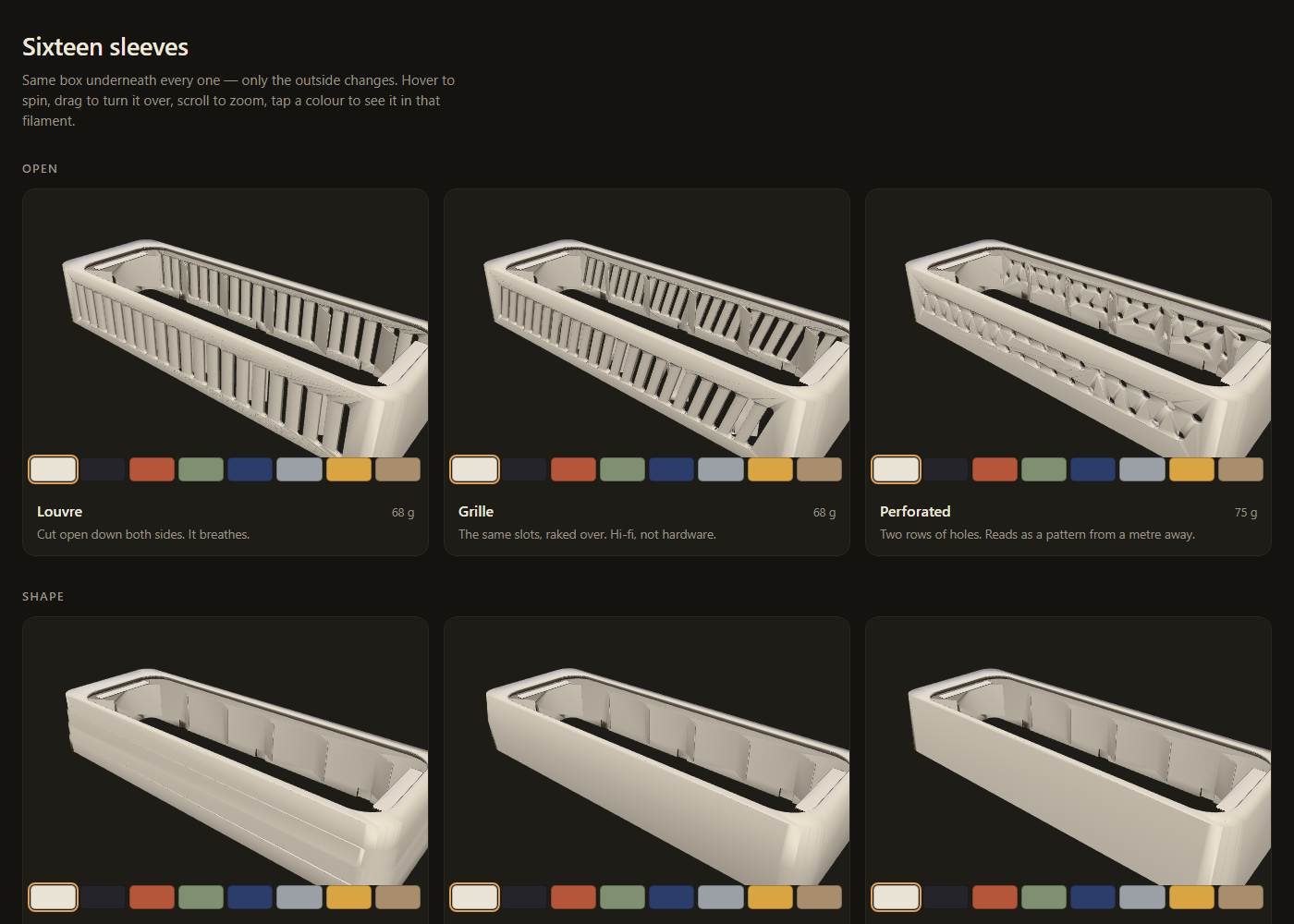
Once the inside is settled, the outside is free, which is the fun part. Every style is the same shell with a different skin, and each one prints between 68 and 110 grams:
- Louvre — cut open down both sides. It breathes.
- Grille — the same slots, raked over. Hi-fi, not hardware.
- Rams — one groove, one chamfer. Braun would have shipped it.
- Column — deep flutes with a base and a capital. A little temple.
- Cleat — a tail with two pegs. Wind the spare cable round it.
- Block — nothing on it at all, and that is the point.
The plate is on the printer as I write this — the shell plus one more Schablone, so that if the sleeve is wrong I find out from a flat 30-minute part rather than from the four-hour one.