Windows brightness that steps like it should
Windows moves screen brightness in jumps of ten. At the top of the range that is fine. At the bottom it is the difference between "too dark to read" and "too bright for a dark room", with nothing in between — which is precisely where you are every night.
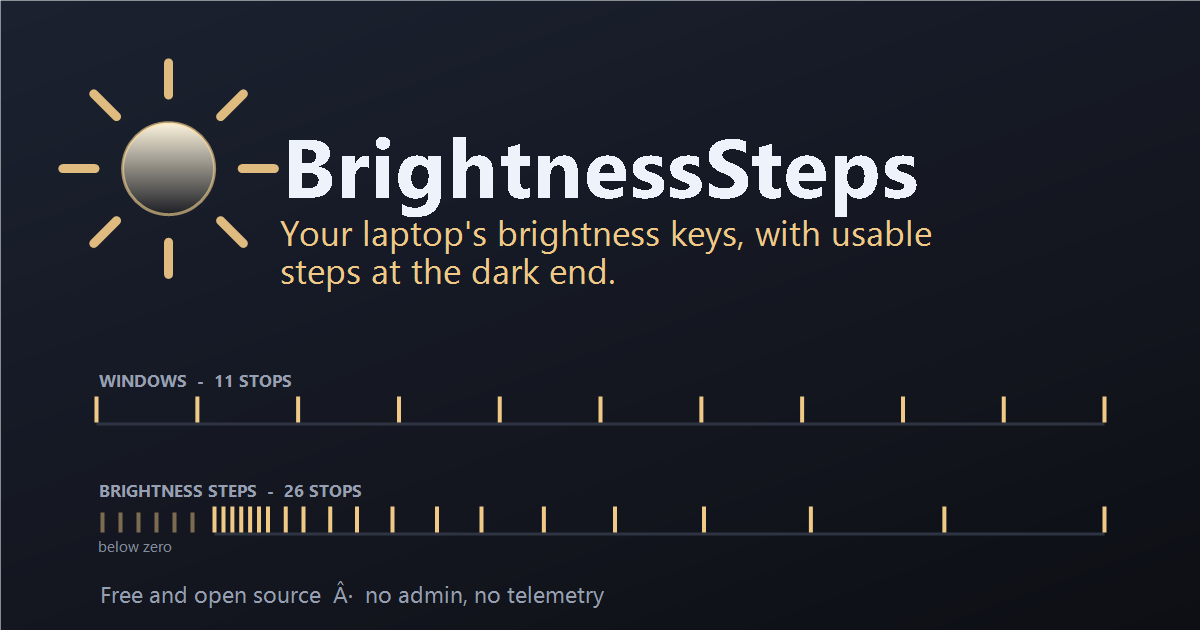
So the two keys get taken over, and the ladder gets rewritten:
0 1 2 3 4 5 6 8 10 13 16 20 25 30 37 45 55 67 82 100
Single-point steps up to six, then gradually wider, so that every press is about the same relative change rather than the same absolute one. Twenty rungs of real brightness, plus six more below hardware zero: most laptop panels bottom out at a backlight level that is still too bright in a properly dark room, so the last rungs dim with a black overlay, down to a fully opaque sheet. The level popup draws above the sheet so there is always something visible, and the sheet belongs to the process, so killing it always gets the screen back.
The part that took the actual work
Grabbing a brightness key sounds trivial and is not. Doing it by scancode or key
position means guessing what each vendor did, and the guess is wrong often. So the
keys are matched on the standard HID Consumer Page usages 0x6F and
0x70 — Display Brightness Increment and Decrement — decoded through the
device's own HID report descriptor. Not scancodes, not key positions, not the state of
the Fn key.
And when a vendor uses its own usage page instead of the standard one, the app does not guess either: it asks. Setup listens to every HID collection on the machine while you press your darker key, then your brighter key, and takes the signal that appeared for one and not the other. That covers vendors nobody has ever tested, without anybody having to know what they did.
It installs per user, so there is no UAC prompt, and it is not code-signed, because a certificate costs more per year than this will ever make — Windows will call the publisher unknown and you will have to click through it. It drives built-in laptop panels only; external monitors need DDC/CI over the video cable, which is a different mechanism entirely. Developed and measured on exactly one machine, a Surface Book 3.