The pen-and-paper game my brother invented
My brother made up a role-playing game on paper. You solved things in it — the way you poke at a crime scene in a Batman or a Hitman game, except it was pencil, and it was top-down because paper is top-down. That is the whole origin. Lamy is that game, in a browser tab, and it is the one thing here I kept coming back to for five weeks instead of a day.
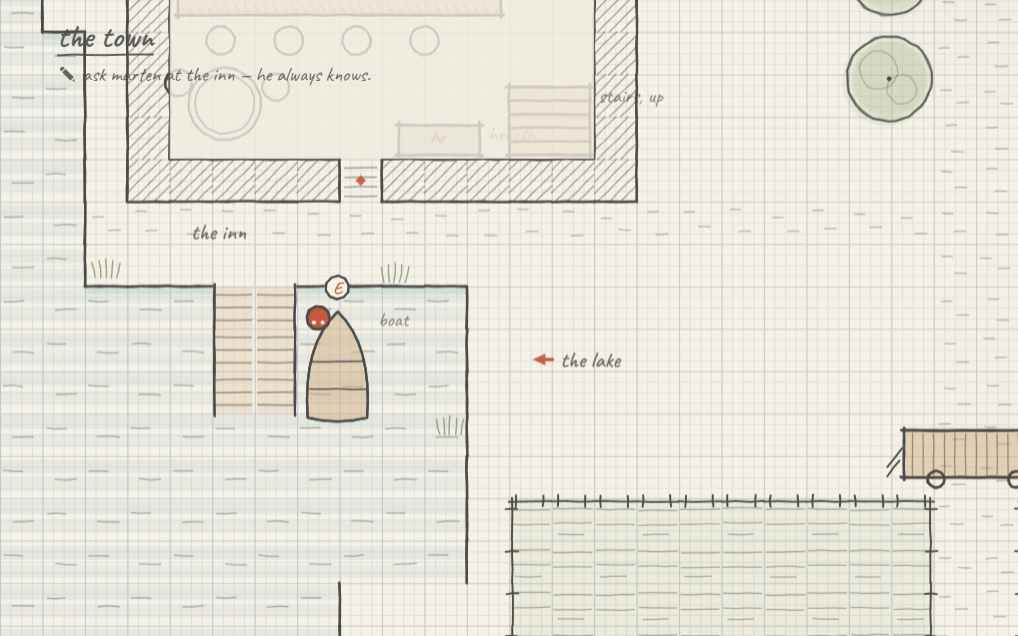
Colour means you can touch it
The look came out of eleven style prototypes on the first afternoon, and none of
them won outright: 001 felt like actual paper, 010 coloured the living things best,
007's watercolour was right for scenery. The eleventh, "Kolorit", is those three
merged, and it is still what the game draws. A later detour into washed-out 3D — Link's
Awakening on the Switch, but sepia — got scratched after a day and sits in
attic/; the pencil was the original idea and the only one that meant
anything. What makes it work is not the paper texture, though. It is one rule.
Anything with a flat tint is interactive. Anything in soft watercolour wash is scenery. Uncoloured pencil is furniture. The terracotta accent is reserved for three things only — you, exits, and fire. NPCs are tinted because they are alive.
The important part is that the renderer derives the tint from whether an
object has a use handler. You do not colour something in; it becomes
coloured by becoming usable. So the visuals and the gameplay data cannot drift apart,
which is the failure mode of every hand-tinted map I have ever made. Press Tab and
you see the same scene as a blueprint, with the same objects outlined in orange for
exactly the same reason.
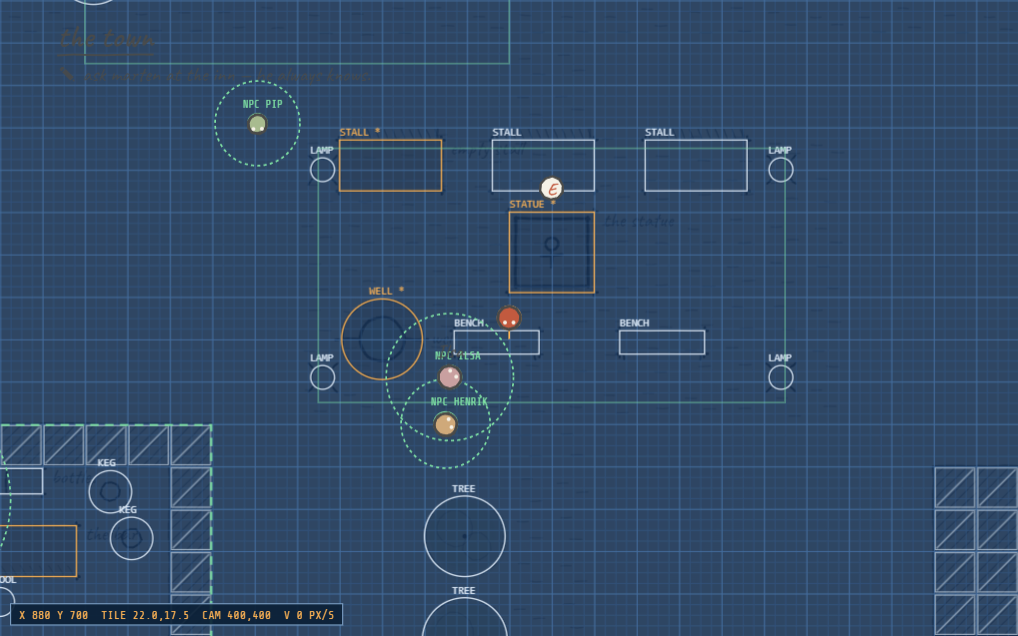
use — the same list the
painter reads.One map, one scale, no fades
The first version did what games do: a house was a doorway that swapped you to a bigger interior map. Then the obvious objection, which is the paper game's objection:
"a house being smaller on the outside than on the inside makes no sense … there is also no need to switch maps."
So the town is one sheet at one scale. Houses are real-size structures whose rooms are physically inside their own walls, and walking through a door gap simply walks you inside. No transition, no loading, no second map to keep in sync.
What replaces the map switch is a sight rule, borrowed from Diablo and Baldur's Gate: standing outside washes every interior to a ghost, standing inside washes the world away. And because it would be absurd to talk through a wall you cannot see through, interaction is gated on the same zones — you cannot use or speak to anything that is currently washed out.
The four rounds of "the walls are still not moving"
The level editor is the least glamorous part and took the most arguing. Rectangle- select a building, drag it, and the building moves — except the painted wall tiles stay behind, four separate times, over three days, because I kept fixing the logical walls and not the paint:
- "I cannot select exactly the building — when I click inside I move the zone, when I click outside it adds a border of 1 tile"
- "hmmmmm ok but e.g. the walls are not moving… can't wall tiles also be part of a selection?"
- "walls are still not moving with the selection… maybe also add a tiny version number on top so I know if I have the latest"
- "I do not mean the logical walls… I mean the paint tiles for the walls. And I am on v24a"
The version number in the corner was the actually useful request. The rule that
came out of it: the editor owns geometry and nothing else. Ctrl+S regenerates
js/world-map.js wholesale (keeping a .bak), object
ids survive every save, and all the writing — dialogue, quest stages, NPC
behaviour — lives in world.js attached to those ids. Nothing I wrote can
be lost by dragging a house.
The first thirty minutes
Halfway through I stopped building the mystery and started building the opening,
on the theory that the first thirty minutes are the ones that decide whether anyone
sees the rest. There is no title menu, so this is what every open plays — with
C on the first screen as the quiet way back in if you have been here
before:
- a studio card, small and white on black
- the legend, told on five carved stones: a lady watched the lake, the town wrote her name in bronze, something in chains under the water, her name is the lock
- a few seconds of film
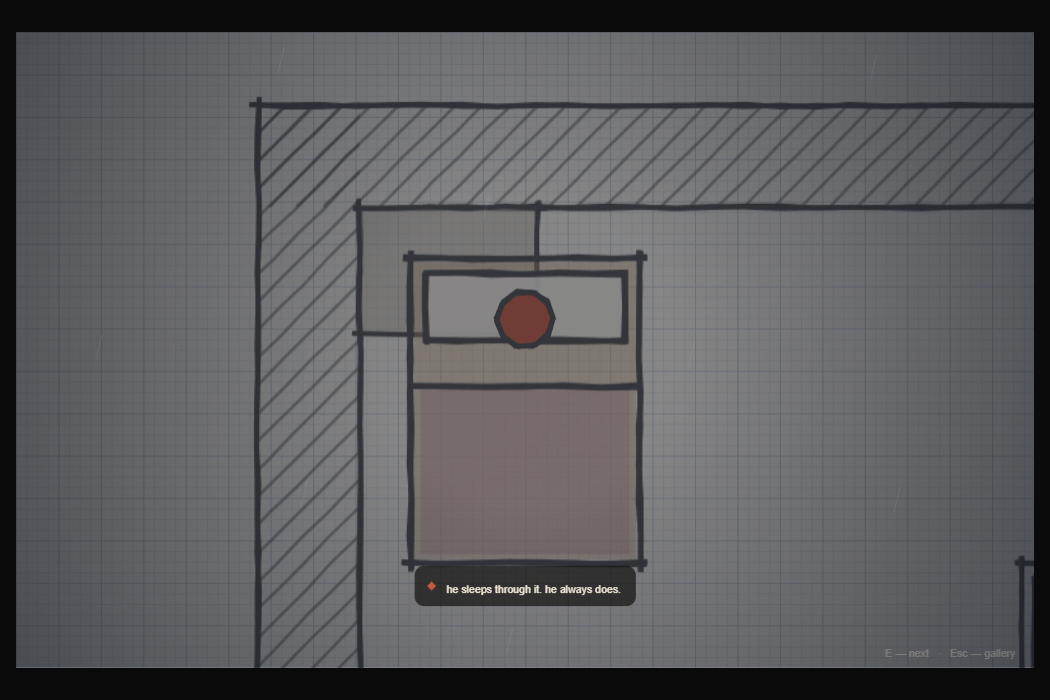
- a dream in which you are the antagonist — a knight who arrives down the southern road no player is allowed to use, and whose power is an eraser. He unwrites the name on the statue, the well rope, the oars. Those are the exact three crimes you will spend the daytime investigating.
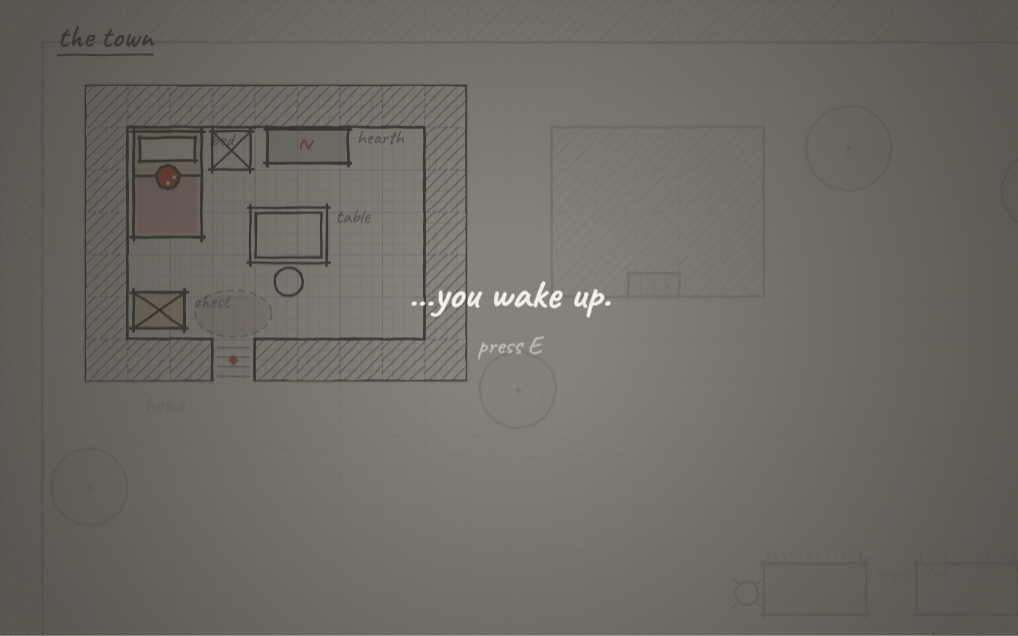
- white, then black, then you wake up in bed not sure any of it happened
- the opening credits play over your first step outside
Two rules got hammered out here and they are the two I would keep for any game: one speaker per text box, and write it for a bright twelve-year-old. The first draft of the legend was cryptic in the way that feels deep while you write it and reads as evasive to anyone else.
Eight cold opens in one night
The last real session was nothing but openings. Eight prototypes, single constraint — drama — sharing one small cinematic toolkit: a drowned bell, a night procession, the name coming apart, the lake rising, a stone door, two sleepers, a tapestry, a ferryman. The ferryman was cut by morning. Then one attempt at gluing the best bits into a single cut, which earned the fairest note of the whole project:
"00 just feels SO weird, completely incoherent… like you glued stuff together without any continuity."
It was. Two coherent full cuts replaced it, each one story from credits through setup, dream, and waking. Cormorant Garamond and Fondamento, after a page of nothing but font candidates.
All of the sound except the music
Wind, water, birds, footsteps, thunder, bells — all WebAudio, generated live, no files. Music is the one exception, and it is filed by settlement size rather than by mood: village gets a light harp-and-recorder track, the next town up gets something fuller, a proper city gets a market. Two of those three rungs play in towns that do not exist yet. Getting the first one right took a few rounds of "the song you picked is medieval city, but I need happy-go-lucky beginner vibes".
Where it actually stands
One mystery is playable start to finish — the lady of the lake — and it ends on an end card. A headless test drives the whole thing every time I touch the engine: walks the house-to-plaza route for real, then asserts on flags and on the literal dialogue lines, so that "the mark burns across the oars" failing is a test failure and not something I find out about in three weeks.
What it is not: it is a keyboard prototype of something meant for a controller and a TV, there is no second mystery, and the town is one town. But it opens by double- clicking a file, it has no build step and no dependencies beyond two Google fonts, and the pencil map still looks like the thing my brother drew.