Light cycles: a flat grid, then the headset, then shared rooms
You ride a light cycle across a grid, and it leaves a solid wall behind it. You can only turn left or right. Hit any wall, your own included, or the rail at the edge, and you are out. The last rider still moving wins. This one went through three versions in four days. On 25 January it was a flat canvas game against bots. The same day it became a WebXR arena for the Quest 2. On 28 January it got a lobby where you type a room name, and other people who type the same name ride in the same arena.
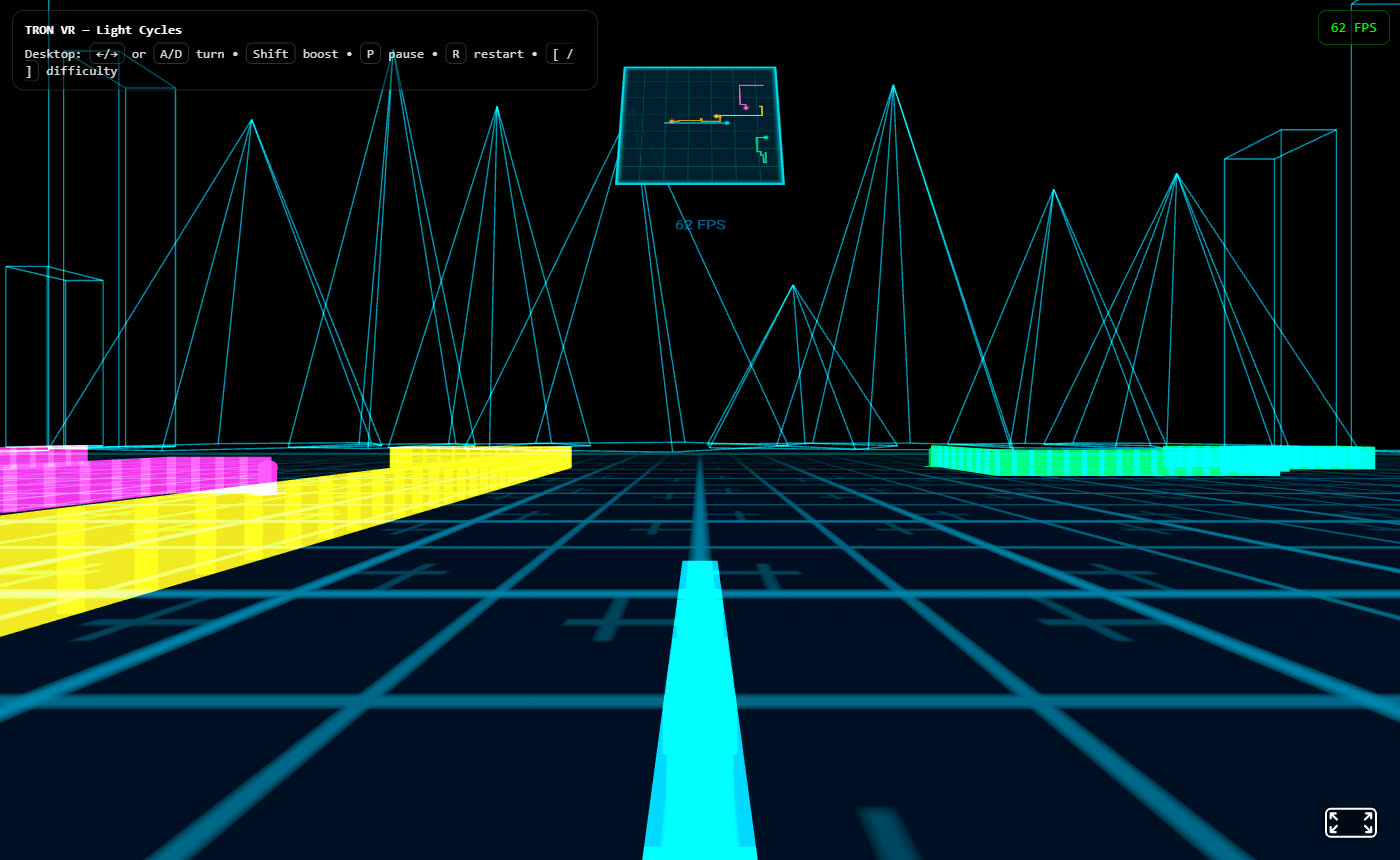
Three ways to steer
On the desktop it is the arrow keys or A and D, with Shift for a boost that cuts each step to 72% of its usual time. In the headset the left stick turns: flick it left or right, and it has to come back to the centre before it turns again, so one flick is always one turn. The right trigger boosts, X and Y change the difficulty, A restarts. On a phone there are two big arrow buttons at the bottom left and a boost button at the bottom right, and the day the rooms went in those buttons were made larger for small screens.
The arena is 140 by 140 cells of 60 cm, closed in by glowing rails. On 28 January it also got a horizon: a ring of wireframe pyramids and towers around the arena, so you can tell which way you are facing.
Bots, and rooms
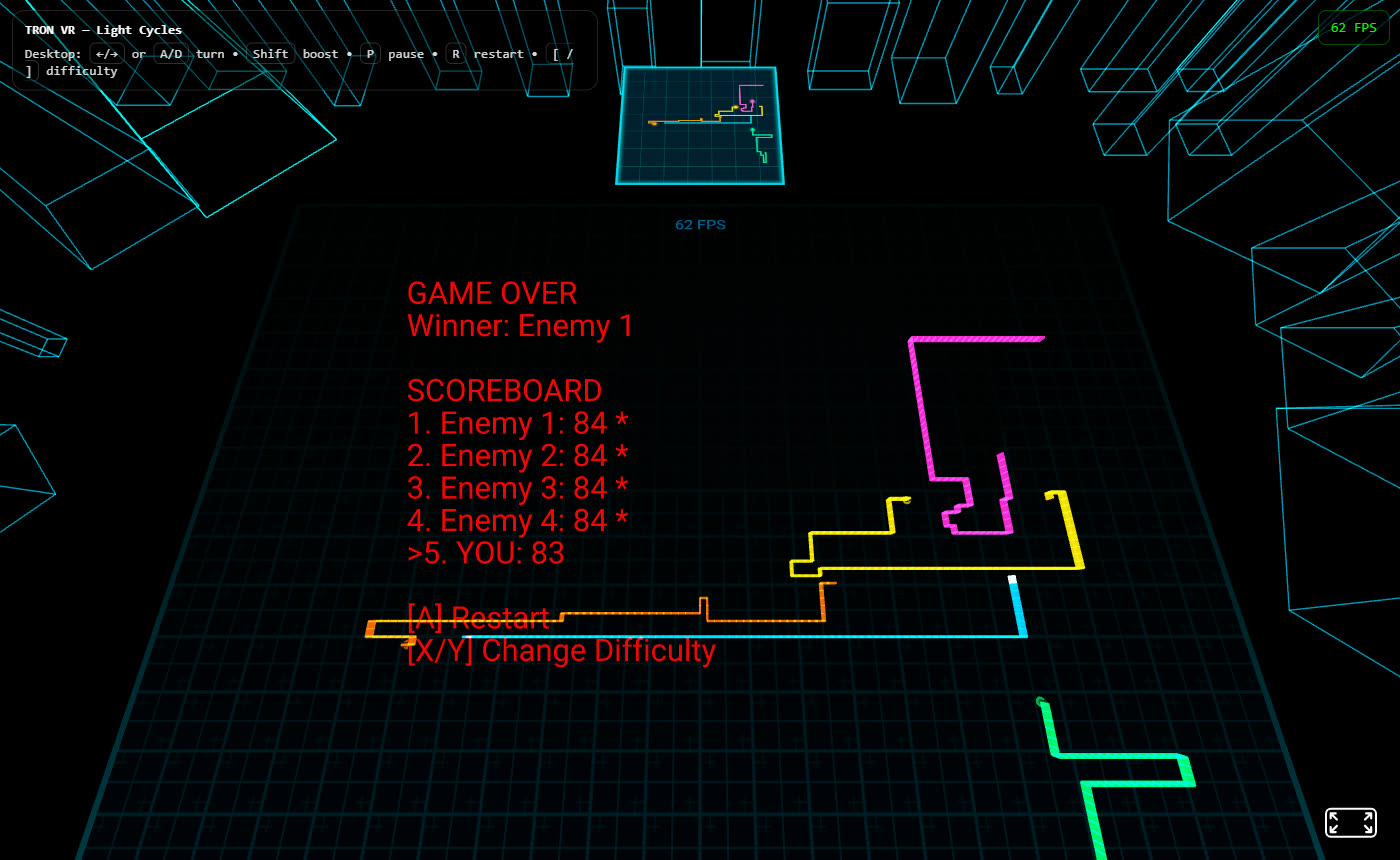
Alone, you ride against bots. Easy brings three, Normal four, Hard five, Insane six. Each one looks a few cells ahead before it turns, from 6 cells on Easy to 15 on Insane, and the harder ones more often head straight for you. When a round ends the camera rises over the grid and a scoreboard ranks everyone by the length of their wall.
Rooms run on a small PartyKit server of 405 lines. Each client moves its own rider and reports every new cell. The server keeps one grid with every wall in the room, checks each move against it, and decides who dies. If two riders swap cells within 200 milliseconds it counts as a head-on crash, and both go. Every 50 milliseconds it sends all positions to everyone. A rider that has not reported for five seconds is removed. There are six starting spots, each new rider gets the first colour nobody is using, and the end screen says who won or that it was a tie.
- built
- 25 January 2026, the flat and the VR version; the rooms on 28 January, eight commits between 01:34 and 18:25, on a Mac
- runs on
- desktop browsers, phones (it installs as an app on iOS) and the Quest browser
- made with
- A-Frame 1.5 and WebXR, one 2,187-line HTML file for the game, a PartyKit server in TypeScript for the rooms
- before that
- a 568-line version on a flat 2D canvas, against bots with the same difficulty levels
Still rough
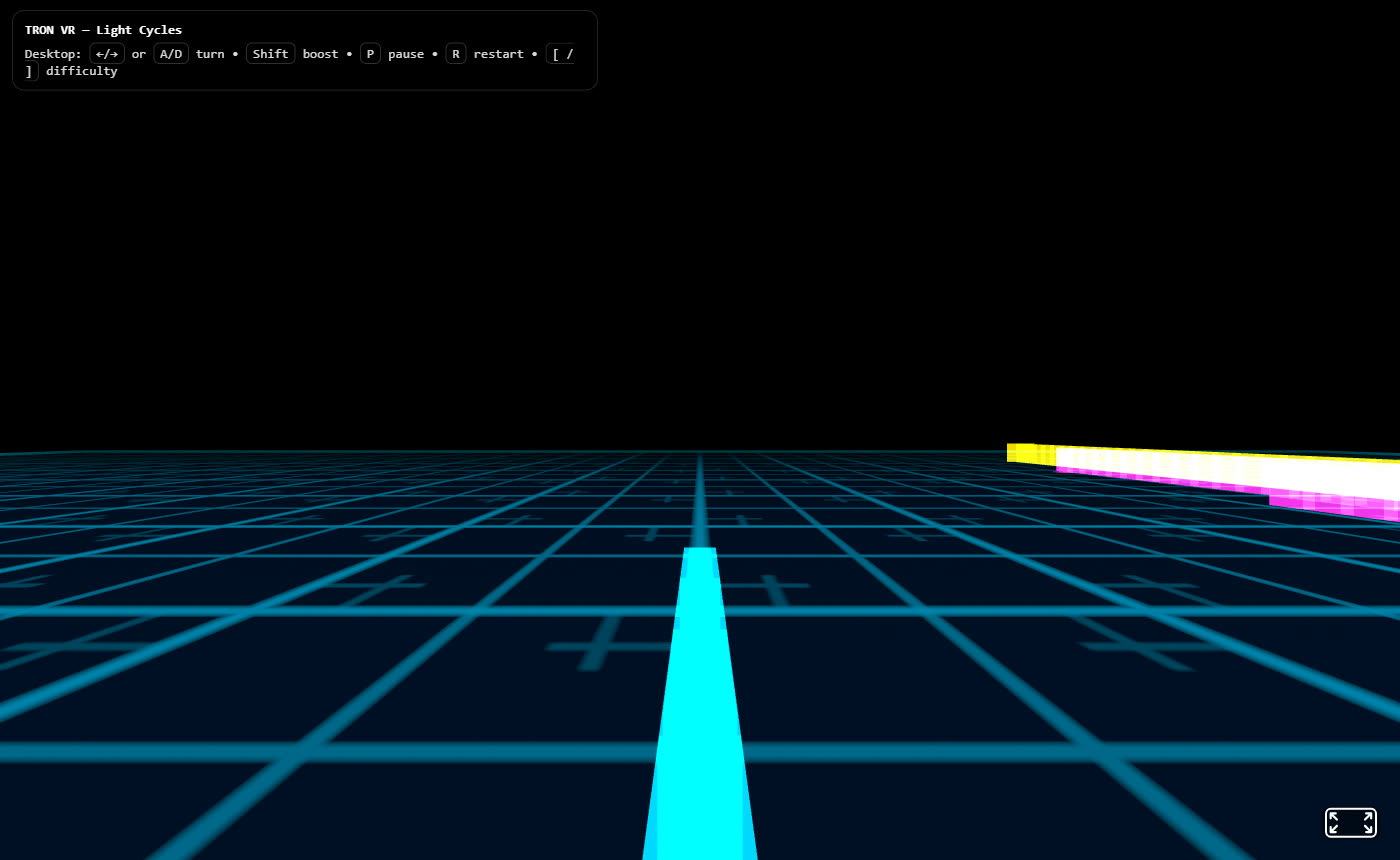
The rooms are not online. The version at the link above is the one from 25 January, so it has no lobby, no skyline and no minimap, and the screenshots of the newer one were taken from the repository, run locally. The server trusts the clients to report their own position, which is fine among friends and nothing more. The end screen has a quirk: in the round above it named Enemy 1 the winner while four bots were still alive and tied. And in Chrome's phone emulation, in landscape, the camera sits so close that the grid fills the screen. This was built on a Mac, so there is no record of it being played on this laptop, and this post has no quotes.